


Modernized access for USGS rating curves is now available
A new STAC API provides access to rating curve files. This API will replace the ratings depot in winter 2026.
Modernized access for USGS rating curves is now available
The USGS publishes rating curves describing the relationship between stage and streamflow at a monitoring location. Historically, these curves have been published at the NWISWeb Ratings Depot, available at https://waterdata.usgs.gov/nwisweb/get_ratings.
Rating curve files are now available from the USGS Water Data STAC API, available at https://api.waterdata.usgs.gov/stac/v0/. The STAC (short for “SpatioTemporal Asset Catalogs”) API allows users to search across USGS data collections using a standardized metadata format and provides access to data in its native formats, providing a modern, standardized interface for discovering and accessing available data. Documentation for how to use this API to access rating curve files is available at https://api.waterdata.usgs.gov/docs/stac.
The STAC API provides access to rating curves in identical formats to the Ratings Depot; there is no change being made to how to read or interpret these files. The URLs to access these files will change, however. For example, the file located at https://waterdata.usgs.gov/nwisweb/data/ratings/exsa/USGS.06652000.exsa.rdb will now be downloaded from https://api.waterdata.usgs.gov/stac-files/ratings/USGS.06652000.exsa.rdb.
Rating curves in WDFN
Rating curves are also accessible in WDFN on the Monitoring Location Pages (MLPs). When viewing continuous discharge on an MLP, you can download the base rating or shift-adjusted rating curve used to compute discharge at the monitoring location using the “Download data” action button. Check the box next to the rating curves you want to download, then click the “Download” button. If you have specific questions about the rating curve for a monitoring location, you can contact the office that manages it using the “Questions or Comments” form at the bottom of the page.
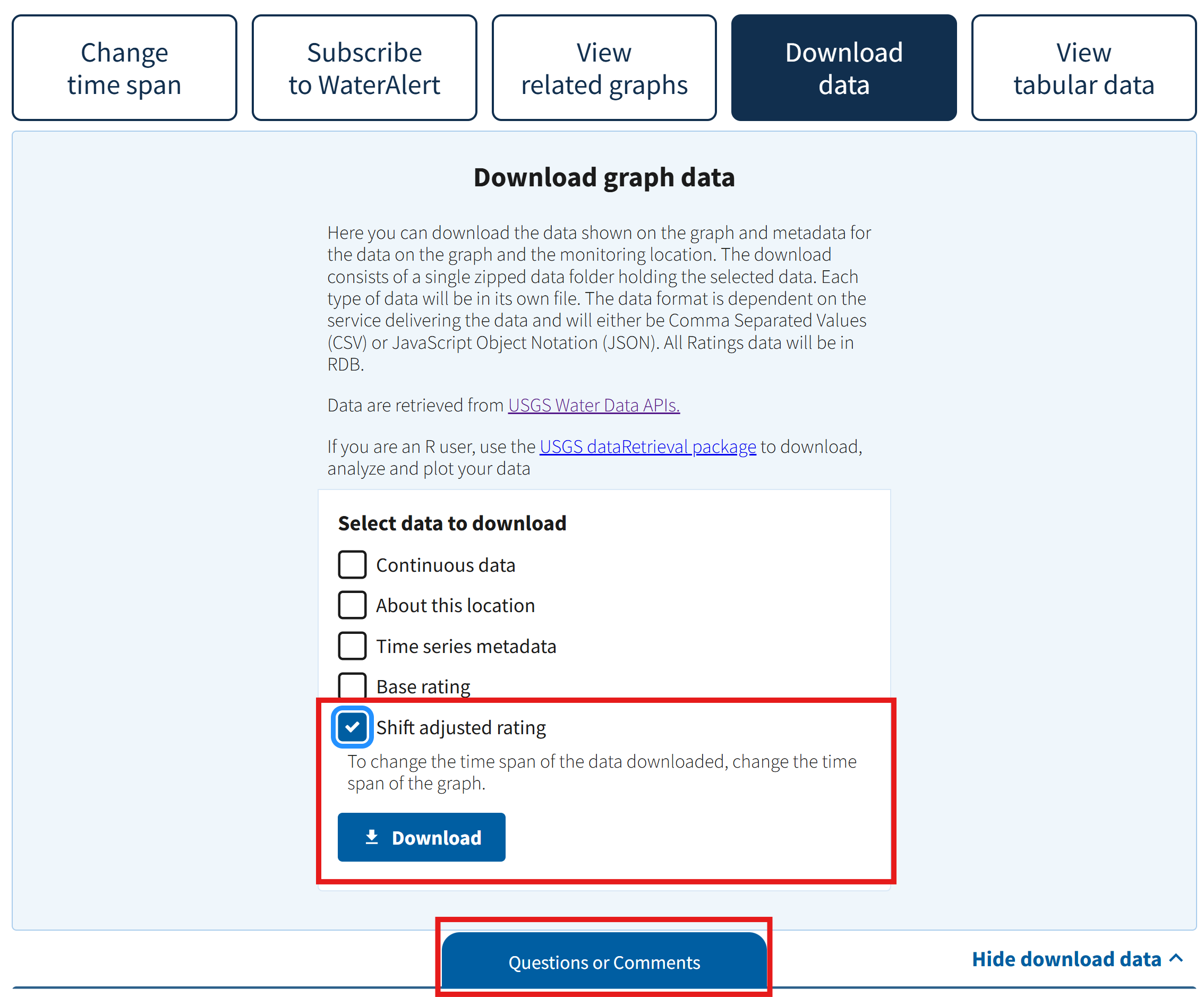
Inside the Download data action button on the MLP when graphing continuous discharge data, you can download the base rating or shift-adjusted rating curve. This example from the Wabash River at Terre Haute, IN (USGS-03341500) shows how to download the rating curves. Use the Questions or Comments link at the bottom to contact the office that manages the location with any specific questions.
Decommission of NWISWeb
Now that rating curves are available through the Water Data STAC API and to download in WDFN, we have decommissioned the Rating Depot and these pages will no longer be accessible. In Decommission Campaign 3, the legacy NWISWeb URLs will be redirected to modernized WDFN webpages when possible, or to relevant resources to help you find the data you were looking for on new WDFN webpages. After this time, the STAC API will be the only way to access rating curve files. Users are recommended to migrate to the STAC API before this time.
All legacy NWISWeb URLs will be decommissioned in Decommission Campaign 3. Look at the URL in your browser window (for example, waterdata.usgs.gov/ca/nwis/ratings). For rating curves, https://waterdata.usgs.gov URLs will be decommissioned that include:
/ratings/get_ratings
Learn more about the decommission of NWISWeb and stay up-to-date with our decommission timing and progress by following along with the WDFN Blog.
We’re here to help
We understand that change is hard, and some of these changes might feel sudden. We’re here to help. We have staff ready to help you make the transition to using WDFN webpages should you need it. Please reach out to us at wdfn@usgs.gov with any questions. You can get regular updates about the modernization and decommission effort sent to your inbox by subscribing to the Water Data for the Nation newsletter.
The WDFN websites and services advance the way we deliver water data, and we are focused on continual improvement. Our team uses user-centered design processes to determine what to prioritize next. Let us know how the WDFN pages are working for you by emailing wdfn@usgs.gov.
Categories:
Related Posts
Peak Measurements in WDFN
August 14, 2026
There has been a lot of change to how you access USGS water data as we work to modernize data delivery in WDFN and decommission NWISWeb. As we centralize data delivery in WDFN, we have described different types of water data according to data collection categories. We re-organized and expanded the data collection categories that are delivered on the Monitoring Location Page and are now working to deliver additional data collection categories on WDFN. This blog is part of a series to help orient you to where you can find different types of data in WDFN pages and services. In this post, we focus on how you can access peak measurements in WDFN.
Modernization of Statistical Delivery and WaterWatch Decommission
June 10, 2025
USGS is modernizing how statistical information is delivered through a suite of new features and products. These are replacing WaterWatch, which offered unique statistics delivery that differentiated it from the core data delivery through legacy NWISWeb. WaterWatch and Water Quality Watch are set to be decommissioned by the end of 2025 as new products become available. This blog details where you can find the statistics previously offered on WaterWatch.
Big changes to USGS Water Data
May 28, 2025
Public USGS Webinar: NWISWeb Decommissioning Campaign 3
NWISWeb launched real-time data pages in 1995 and has hosted more than 7 million annual unique visitors, billions of successful page requests, and terabytes of data delivered. After several years of modernization, we are beginning the final decommissioning or turning off of legacy NWISWeb webpages. This means that pages that you may have relied on for years are going away.
This webinar shared information on NWISWeb Decommission Campaign 3, which will retire all remaining NWISWeb pages and WaterServices. Campaign 3 is expected to be ongoing from November 2026 through February 2027.Announcing V1 of the WDFN APIs
September 4, 2026
Public USGS Webinar: NWISWeb Decommissioning Campaign 3
NWISWeb launched real-time data pages in 1995 and has hosted more than 7 million annual unique visitors, billions of successful page requests, and terabytes of data delivered. After several years of modernization, we are beginning the final decommissioning or turning off of legacy NWISWeb webpages. This means that pages that you may have relied on for years are going away.
This webinar shared information on NWISWeb Decommission Campaign 3, which will retire all remaining NWISWeb pages and WaterServices. Campaign 3 is expected to be ongoing from November 2026 through February 2027.Additional field measurements are coming to WDFN
June 25, 2026
Water Data for the Nation (WDFN) publishes multiple categories of data collected at our monitoring locations, including both data collected by automated sensors and through manual methods. Manually collected data, which we refer to as “field measurements,” are collected during visits to a monitoring location.